
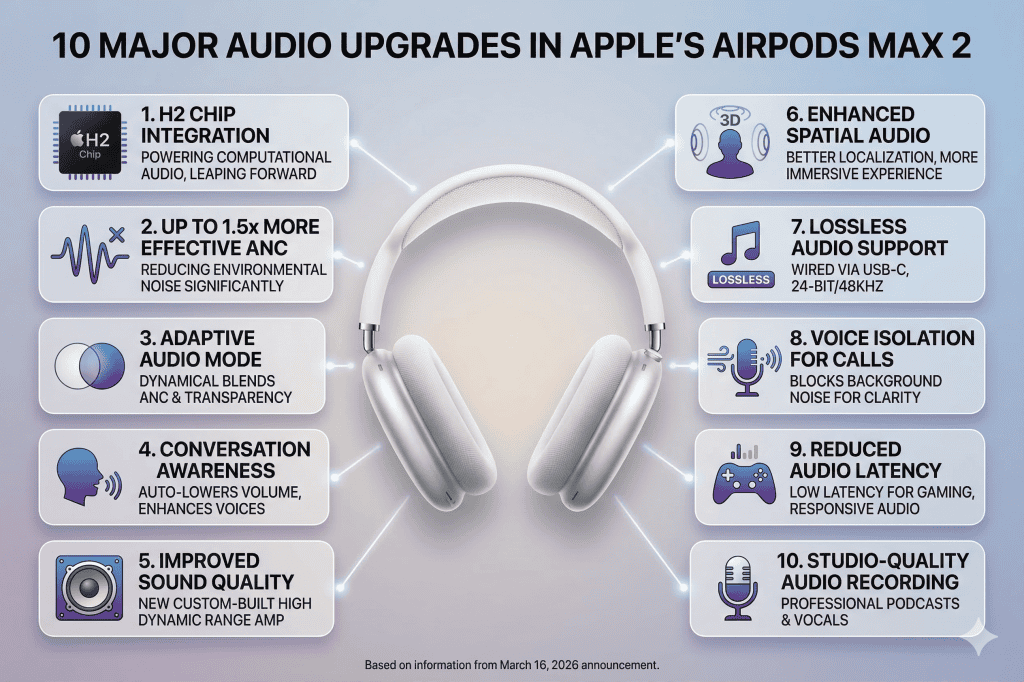

For four long years, audiophiles and Apple enthusiasts have waited for the next iteration of the AirPods Max. Released in late 2020, the original headphones combined iconic industrial design with impressive computational audio, but they were beginning to show their age in an increasingly competitive market of high-end wireless headphones. Apple finally refreshed the lineup with the AirPods Max 2, bringing it up to speed with modern standards.
While some critics were surprised that the outward design remained largely identical, the real story lies beneath the anodized aluminum ear cups. From hardware upgrades to software-driven acoustic enhancements, the new AirPods Max represent a significant leap forward in personal audio. Here are the 10 most critical audio improvements found in the new AirPods Max 2.
1. The Power of the H2 Chip
The transition from the H1 chip to the H2 chip is the single most significant upgrade in the AirPods Max 2. This silicon is the engine behind almost every audio improvement. With nearly double the transistors of its predecessor, the H2 chip allows for advanced computational audio that was previously impossible. It processes sound at 48,000 times per second, enabling more precise equalization and faster response times to environmental noise.
2. Twice the Active Noise Cancellation (ANC)
Leveraging the computational power of the H2 chip, the new AirPods Max 2 feature Active Noise Cancellation that is up to two times more effective than the original model. By using updated microphones and superior algorithms, the headphones can more accurately target high-frequency noises, such as human voices or office chatter, which were traditionally difficult for ANC systems to drown out. This creates a “silent bubble” that feels more profound and less intrusive.
3. Adaptive Audio
A feature first introduced with the AirPods Pro 2 has finally made its way to the over-ear model. Adaptive Audio dynamically blends Transparency mode and Active Noise Cancellation to tailor the noise control experience as you move through different environments. If you walk from a quiet library into a bustling street, the headphones will seamlessly increase noise cancellation without you needing to touch a button, ensuring you only hear what matters.
4. Personalized Volume
5. Conversation Awareness
One of the most practical additions is Conversation Awareness. When the headphones detect that you have started speaking, they automatically lower the volume of your media and enhance the voices of the people in front of you. This makes it effortless to order a coffee or answer a quick question without having to remove the headphones or physically toggle Transparency mode.
6. Upgraded Transparency Mode
While Apple already led the industry in “natural-sounding” transparency, the AirPods Max 2 take it further with Adaptive Transparency. Using the H2 chip, the headphones can minimize the intensity of loud, jarring sounds—like a passing siren or a construction drill—while still allowing you to hear the world around you. This protects your hearing while keeping you socially and environmentally aware.
7. Improved Acoustic Architecture
Though the exterior looks the same, Apple has made subtle refinements to the internal driver housing and the custom-built 40mm dynamic driver. These tweaks result in a wider soundstage and lower distortion at high volumes. The bass is tighter and more controlled, while the high-end frequencies provide more “air” and clarity, appealing to listeners who found the original model slightly too warm or recessed in the treble.
8. Enhanced Personalized Spatial Audio
While Spatial Audio was available on the previous generation, the AirPods Max 2 utilize the latest iOS advancements for a more immersive 360-degree experience. By using the TrueDepth camera on an iPhone to scan your ear geometry, the headphones create a personalized HRTF (Head-Related Transfer Function) profile. This results in more accurate sound placement in a 3D space, making movies feel like a theater experience and music feel live.
9. USB-C for High-Fidelity Wired Listening
The shift from Lightning to USB-C isn’t just about charging convenience. The USB-C port on the AirPods Max 2 opens up the possibility for a more robust wired audio connection. While Apple continues to focus on wireless convenience, the move to USB-C brings the headset in line with the rest of the Apple ecosystem and simplifies the use of high-quality DACs and amplifiers for those who want to squeeze every bit of fidelity out of their Lossless audio files.
10. Better Call Quality with Voice Isolation
Communication is a key part of the AirPods experience, and the Max 2 benefit from improved beamforming microphones and the H2 chip’s processing. A new “Voice Isolation” feature uses advanced machine learning to prioritize your voice and eliminate background noise during calls. Whether you’re walking in the wind or sitting in a noisy cafe, your voice remains clear and centered for the person on the other end of the line.
The Verdict: A Quiet Evolution?
Some users may have been hoping for a radical redesign or a lower price point, but Apple’s strategy with the AirPods Max 2 is clear: if the hardware isn’t broken, upgrade the intelligence. The original design was already hailed for its comfort and premium build, so by focusing on the H2-driven audio enhancements, Apple has addressed the technical gaps that had formed between the AirPods Max and the newer AirPods Pro.
The combination of superior noise cancellation, smarter environmental adaptation, and refined sound quality ensures that the AirPods Max 2 remain at the top of the premium wireless headphone market. For those who prioritize audio fidelity and the Apple ecosystem, these ten improvements make the new model a compelling, if overdue, upgrade.

 English